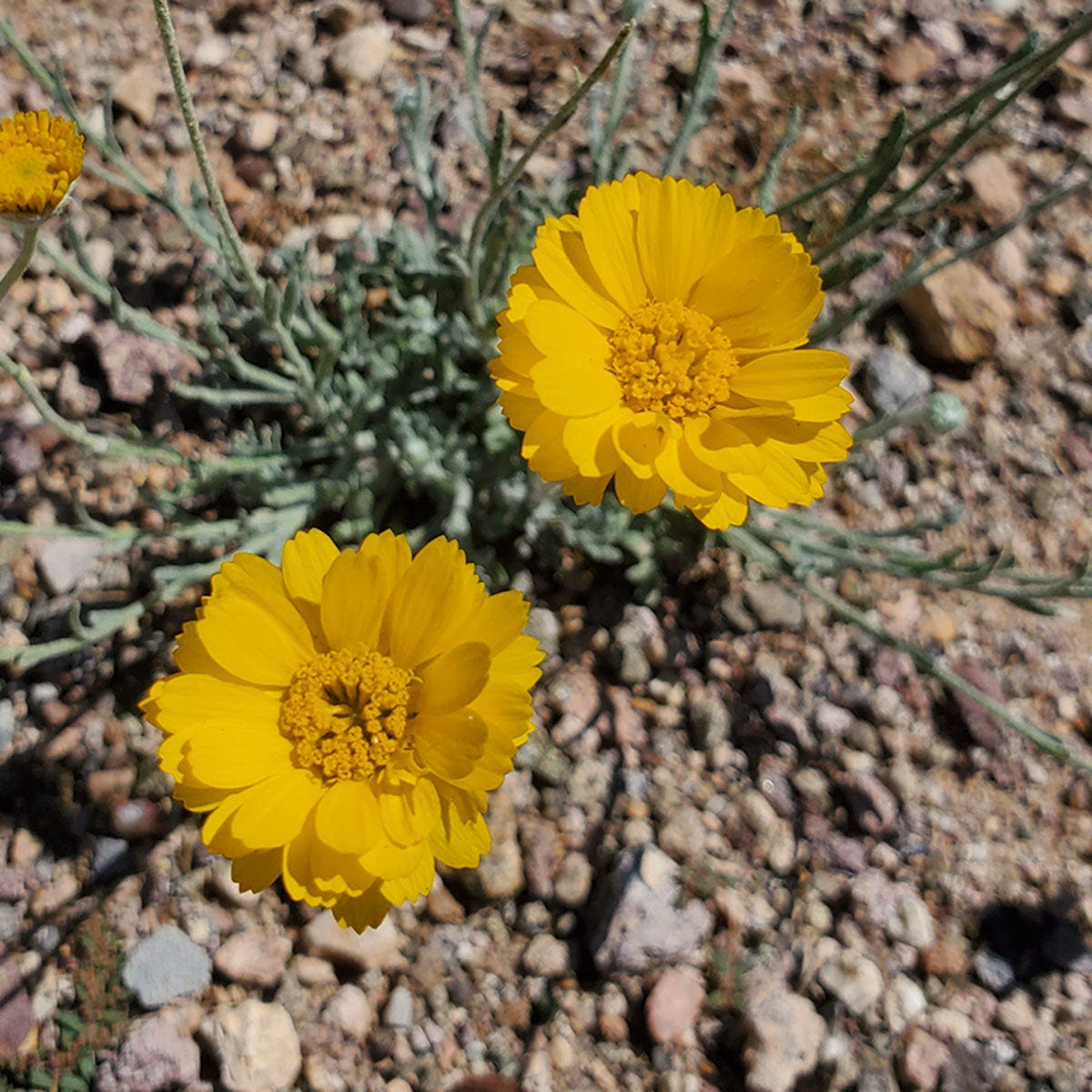
The Desert Marigold
Wikipedia random article generator, #1

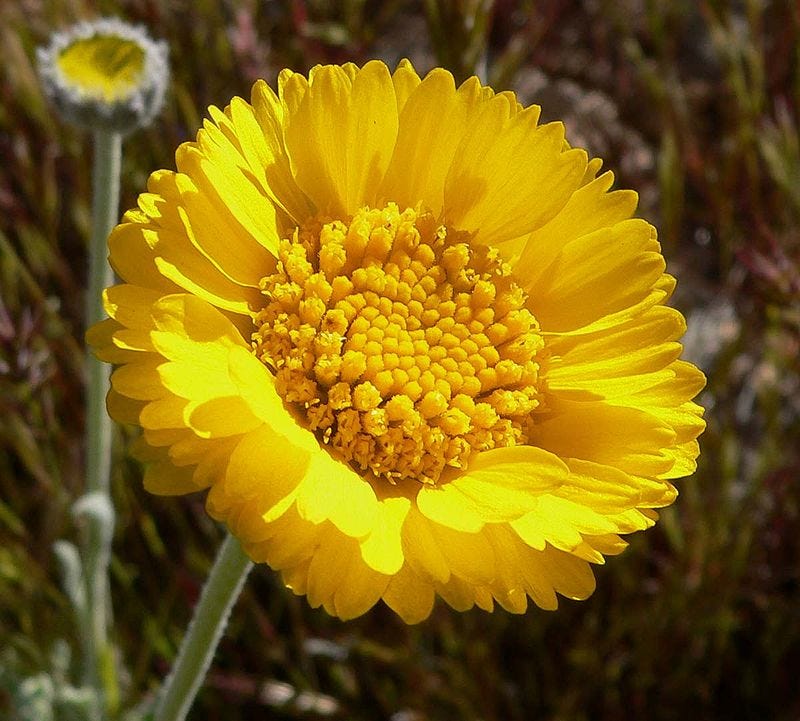
#/media/File:Baileya_multiradiata_flower_1.jpg)
Wikipedia has a random page generator—if you click it, it will send you to one of the roughly 7.2 million English-language Wikipedia articles at random. I thought this would be fun for an article assignment for Tropical Depression. The mission would be to write about whatever I landed on. The first time I clicked it was a stub with no information, so I allowed myself to try one more time. I landed on the page for Baileya, or desert marigolds. Here goes.
§1 Desert marigolds are poisonous to goats and sheep. But don’t worry, they are not poisonous to cattle or horses.
§2 They typically begin to bloom in spring. They are short-lived and can be annuals or perennials.
§3 The panpsychists say that everything has, in some sense, consciousness. Not just other animals, or plants, but also rocks or rubber duckies or rubbers, whatever. Likewise one-celled organisms or the cells in our bodies. A rock has less consciousness, or less access to the stuff of mind or soul, than we do. It’s a matter of degree. Or some say that the rock itself doesn’t have consciousness, but each atom making up the rock does, so a rock is a kind of assemblage of enminded bits. For those in that camp, there is some divide about whether to consider plants as unified individuals or rather collections of individual cells each with their own wee souls. I can’t tell whether this way of looking at the universe exalts or impoverishes the full wonder of consciousness.
§4 Is the splendor of the desert marigold a product of our first-person peephole and the beauty-addicted subjectivity of our minds, or souls, or whatever you want to call it? Would the splendor be splendid if it was unobserved? The flower’s seeds are eaten by doves, sparrows, and finches. Birds have relatively few taste buds.
§5 My family took a walk in a cypress slough a couple years back and perhaps it was business in one hemisphere of his brain that triggered my son to say, “it’s the forest,” and business in the other hemisphere that led him to finger a dirty stone for some time and then announce that it belonged to him. Or perhaps it was something else that can only partially be explained by the material happenings inside of his little skull. I say little, but actually he has a massive head. Back then, it made him look like a cartoon version of a toddler. His head was so big the doctors measured our heads to make sure the situation was plausible. But it seems like everything is fine. He just has a big head.
§6 Maybe you will doubt that the Wikipedia page generator randomly landed on a flower that shares my daughter’s name, but I promise you that’s what happened. If anything, it almost felt like a too-close-to-home pressure when what I wanted out of this assignment was distance. But randomness, if truly random, is under no obligation to feel random. These things happen.
§7 According to The Crystal Bible: A Definitive Guide to Crystals, by Judy Hall, the gemstone labradorite “enhances ‘coincidence control’—the practice of increasing the observed degree of synchronicity and serendipity in one’s life.”
§8 Proponents of the many-worlds interpretation of quantum mechanics hold that under certain quantum conditions, there is a split—a branching—such that the universe proceeds as two universes distinct from each other and with equal claims to reality. I am massively oversimplifying, but that’s close enough for our purposes. This happens quite a lot, most of the time from stuff that has no real impact on our lives, so there are lots of versions of me, each carrying on in his own universe. Or a desert marigold, say. It lives for a couple years, perhaps, but its existence occurs—presumably as vividly real in each—across uncountable universes. If it has some glimmer of consciousness in one universe, so would it have that glimmer in every other universe. If this is true, my mind and yours are in one sense unimaginably vast, but also sharply constrained (which perhaps might explain our minds’ struggle to grasp all this if it’s true). Once the wave function of the universe branches, the “me” in another universe has nothing to do with the me here in this one. Consciousness is local, I guess.
§9 Anyway. In his book on quantum physics and the many-worlds theory, physicist Sean Carroll describes the strangeness of probability in this interpretation of reality. As one example, he types out a long string of 1s and 0s, fifty in all. He then reveals that he came up with this sequence using a “quantum random-number generator.” An instrument makes a quantum measurement of an electron with equal probabilities of being measured as “spin-up” or “spin-down.” This corresponds to 1 or 0. Such a measurement is taken fifty times to get a fifty-digit string of numbers. There are around a quadrillion different combinations that could result. According to Many-Worlds, these measurements (which involve enacting the relevant quantum event to create a new branch) split the universe into a quadrillion different copies, each of which gives a different random fifty-digit number. Okay. But what that means is that while nearly all of the quadrillion Sean Carrolls wound up with a random-looking number to put in his book as an example, there is one Sean Carroll that got all 0s and one Sean Carroll that got all 1s. According to the logic of Many-Worlds theory, this is definitionally true. What would those poor Seans do? “Probably they thought the random-number generator was broken,” Carroll writes. “They certainly didn’t write precisely the text I am typing at this moment.” One in a quadrillion is pretty close to zero, but not quite. If Carroll’s theory of reality is correct, sometimes a universe more or less precisely like our own will have something unimaginably strange happen.
§10 But even in the cozy confines of our universe and classical mechanics, true randomness requires the remote possibility of uncanny coincidence. Our minds are good at interpreting coincidence as magic, but I like to think of it as a little practical joke in the mathematics.
§11 Desert marigolds grow in southern Arizona, southern Nevada, southwest Utah, southwest Texas, and northwest Mexico. According to the the Arizona Sonoma Desert Museum, they “can be found growing on sandy or gravelly soils of roadsides, plains, washes, mesas, and pinyon-juniper communities.” They grow up to a foot or two in height, and perhaps two feet across. The leaves are between four and eight centimeters long. They are unusually tolerant of drought. Wikipedia describes the Baileya multiradiata, one of three species of the genus Baileya, as “sun-loving wildflowers,” but don’t all flowers love the sun? Don’t all of us love the sun?
§12 The philosopher Thomas Nagle famously wrote this on consciousness: “an organism has conscious mental states if and only if there is something that it is like to be that organism—something it is like for the organism.” So the parameters of my consciousness are governed by what it’s like to be me. That’s also the title of a Britney Spears song.

§13 Cannot improve on the prose in Wikipedia: Although called a desert marigold, it is only a remote relative of the true marigolds.
§14 Convergent evolution happens when organisms independently evolve similar traits despite having only a distant common ancestor that lacks these traits. Think of insects, birds, bats, and the dinos we called pterodactyls when I was a kid: all of them can fly, using relatively similar mechanisms involving wings. But each evolved on their own (birds are distant ancestors of bipedal dinos rather than the winged and featherless pterosaurs). Or think of the eye: The camera-type eye used by vertebrates like us can also be found in the octopus, despite our common ancestor being a primitive flatworm something like 750 millions years ago.
§15 Or perhaps two flowers that are not at all closely related happen to each be pollinated by hummingbirds that are drawn to the color red. They might separately evolve toward the same solution to the problem (beckon the hummingbirds!), and at first glance look similar: bright red flowers, small in size, no nectar guides—even if they once looked very different from each other in earlier bee-pollinated ancestors, and haven’t shared a common ancestor for maybe a hundred million years.
§16 A lot of modern evolutionary biologists think this sort of convergence has a good deal of explanatory power about the way things are. I really like the way the late paleontologist Stephen Jay Gould wrote prose, so I enjoy dabbling in his old books and essay collections. But some biologists argue that one of his most famous riffs might be out of date, at least if interpreted too literally. Imagine that you could replay “life’s tape,” Gould proposed as a thought experiment in his book Wonderful Life, and elsewhere: “You press the rewind button and, making sure you thoroughly erase everything that actually happened, go back to any time and place in the past—say, to the seas of the Burgess Shale. Then let the tape run again and see if the repetition looks all like the original.” Gould suggested that things would be unrecognizably different. While stuff would still follow an explicable evolutionary pattern, it was impossible to say how minor contingencies would cascade into wildly different courses. Countless evolutionary steps might be unlikely in their own right, even if they were logically interpretable after the fact on their particular path. “Any replay of the tape would lead evolution down a pathway radically different from the road actually taken,” he wrote. You would never get the same outcome twice. “Any pathway proceeds through thousands of improbable stages. Alter any early event, ever so slightly and without apparent importance at the time, and evolution cascades into a radically different channel.” The existence of human beings, or even something remotely like us, was not inevitable, in this way of thinking. It was just a lotto ticket, in the cosmic array of circumstance, and we won.
§17 But does Gould’s story of replaying the tape underrate the power of convergence? There are obvious constraints of physics and chemistry that dictate how evolution might unfold, but the combinatorial possibilities of genetic mutation are nearly endless. This leads to kind of folk understanding of evolution as a limitless and random process of endless possibility. But certain adaptations are likely to win out. Like the camera eye—it’s such an elegant solution to the problem of how to see on a planet with free light from a sun that very different species arrived at a strikingly similar approach. The word that people tend to reach for when they talk about convergent evolution, according to the paleontologist and evolutionary biologist Simon Conway Morris: “uncanny.”
§18 The Baileya is named after the naturalist Jacob Whitman Bailey, a nineteenth century West Point professor and early innovator in microscopic research. Per Wikipedia: “He devised various improvements in the construction of the microscope and made an extensive collection of microscopic objects and of algae.” In 1852, with Bailey and his family aboard, a steamboat caught fire on the Hudson River. Fifty passengers died. Bailey and his son survived; his wife and daughter did not. That’s all I know about that. Bailey was known for his studies of diatoms, Wikipedia informs me. A diatom is a type of microalgae that generates 20 to 50 percent of the oxygen produced on the planet, Wikipedia informs me, and a group of living diatoms can double every twenty four-hours via asexual multiple fission. Komodo dragons and some monitor lizards can also reproduce asexually, Wikipedia informs me. And so on.
§19 When my wife Grace was pregnant with Marigold, we planned to be surprised about the gender. We had a girl’s name picked out almost immediately, but not a boy’s. We don’t have a great origin story about the name Marigold, we just liked the way the syllables sounded. And we like flowers. I had already proposed “Wild” as a middle name. And we really liked the sound of that: Marigold Wild. Marigold wildflowers are native to Nepal and Mexico, and some of the fifty species of marigolds have become naturalized all over the planet. But of course hybrids abound and the most popular marigolds are a go-to choice for cut flowers. As for desert marigolds, they are remarkable for their heartiness in arid climates. That they are beautiful in their own right according to the taste of human beings is just one of those things. An accident, if that word has any meaning, of evolution.
§20 According to Wikipedia, the desert marigold “provides beauty for gardeners as well as bounty for local pollinators, all while demanding little in return.”
§21 In principle, you could imagine all sorts of oddities if aliens evolved on a similar planet, or you ran back the tape on our own—or you could imagine that the oddities became altogether unimaginable. In practice, though, to take an oversimplified example—using an even number of symmetrically arranged legs for getting around on land is an efficient enough solution that it’s not definitively obvious that more fanciful approaches would win out in natural selection. (Asked about wilder sci-fi notions like life on a neutron star, the astrophysicist Adam Frank said he prefers to search for what we know: “Our understanding of life is that it is principally driven by molecular shenanigans.”) Our galaxy houses an estimated 10 to 40 billion earthlike planets. If there is a technologically advanced civilization of highly intelligent beings on one of those planets—well, who knows what they would look like! But we might hazard a guess that they are bilaterally symmetrical. Given the constraints of physics, that’s how things have shaken out for most animals on Earth. Evolution is still full of contingent quirks and randomness, so the aliens would look very different than us, and there is little chance that any sci-fi has come even close to a correct guess. But maybe they would look like exotic animals, weird but uncanny, with recognizable similarities to creatures here on Earth. Maybe they would even have some uncanny similarities with smarty-pants earthling apes. Before you get too excited, remember that our planet’s biodiversity is a tiny, recent blip in the history of Earth. For a very long time, life was a considerably more gooey and drab affair. Whether or not there was consciousness simmering somehow in the primordial sludge, no one had a brain. If we use our planet as a model, odds are that most life out there, if there is life out there, is slime.
§22 Consider the wild flowers in the field, how they grow, Jesus told his disciples, they toil not, neither do they spin. Perhaps evolution or Creation or the Logos or whatever is best understood as a dazzling algorithm. Perhaps we creatures are bound to take notice of such contingent wonder, each in our own way, randomness and convergence conspiring for this peculiar show: The opulence of the present tense in our reckoning. Cities, songs, prayer, telescopes and microscopes, galaxies and particles, disembodied thoughts, the texture and truth of those thoughts, peacocks, moths, shooting stars, fossils, fire, gemstones, desire, stardust put to use, desert marigolds, daughters, etc.
§23 The gender surprise plan didn’t work out. After a medical procedure to check on the little one’s health, a nurse called and left a message to say that everything looked good and “she” was perfect, and so on. In case there was any confusion, she made mention of the various body parts looking great, including the “girl parts.” Or that’s how I remember it; my wife, Grace, has no memory of that detail. Anyway. So much for the surprise. Grace initially told me about the accidental reveal without telling me the gender, so I had a little longer to nurse the mystery. I suggested that maybe she just shouldn’t tell me, and at least I would still be surprised—an idea that seems insane in retrospect. The next morning, when I opened the front door, there was a pot of marigolds. This was one of the first times I sensed the shape of my love for Marigold; this was not the first time I felt thankful for Grace and her graces.
§24 About that medical procedure: This is a memory that requires a little scraping to fully retrieve. At around twelve weeks or so, our midwife called us in to say that screening tests had showed that there was a risk of Edwards syndrome (trisomy 18). We had never heard of that, and our midwife didn’t do a very good job of explaining. So we looked on Wikipedia. We learned that 60 percent of impacted pregnancies end in miscarriage or stillborns. Among those who are born, we learned that somewhere between 60 and 75 percent survive one week; between 20 and 40 percent make it to their first month; less than 10 percent make it past the their first year. Around one percent make it to age 10. According to the Cleveland Clinic: “Often, the condition is so severe that babies who survive being born are treated with comfort care.” Our midwife, for some reason, had mostly focused on low-set ears when she explained what that the risk had popped up on the screening test. My heart was beat-beat-beating in an unfamiliar way. I read aloud from Wikipedia and from various medical websites. Grace wept.
§25 From Wikipedia: “Children born with Edwards’ syndrome may have some or all of these characteristics: kidney malformations, structural heart defects at birth (e.g., ventricular septal defect, atrial septal defect, patent ductus arteriosus), intestines protruding outside the body (omphalocele), esophageal atresia, intellectual disability, developmental delays, growth deficiency, feeding difficulties, breathing difficulties, and arthrogryposis (a muscle disorder that causes multiple joint contractures at birth.” According to Wikipedia, Trisomy 18 occurs in around 1 in five thousand live births—though that understates how common it is since most cases end in death prior to birth. It’s caused by an extra copy of genetic material on the eighteenth chromosome. “The incorrect number of chromosomes is unpredictable and random,” the Cleveland Clinic explains. Randomness is how we came to be. But it also means that biology is prone to the occasional bad draw, say once every five thousand times. Abnormalities are a normal feature of genetics.
§26 What we know now and didn’t know then is that the kind of screening test we had done often shares test results with extremely low specificity—lots and lots of false positives. Here’s some good New York Times reporting on the issue. But that story was published five years later; all we knew at the time was that we had done a screening test, a red flag popped up, and it was something close to a death sentence. So I spent a lot of time on the phone with someone from the testing company who was smart and kind but either had strict limits on what she could say or didn’t really understand statistics very well. I wanted numbers. I would have liked to know, for example, data on the test’s specificity. What we got instead was a hazy sense that the chances of a true positive were significant but less than fifty percent. Maybe one in four? I doubt that was right, but that was the closest we could get at the time to some sense of the odds. All this became a weird footnote in the story of our first child, who was in fact fine. But we didn’t know that, and spent a lot of mental effort reckoning with the worst-case scenario. Years later, it’s like the faintest emotional scar, merely hypothetical trauma. If you flip a fair coin twice, the odds of getting heads twice in a row is one in four. We were terrified.
§27 The Baileya multiradiata species has a bright yellow flower head with around three dozen ray florets. This is the first time I’ve encountered the term “ray florets.” I love it.
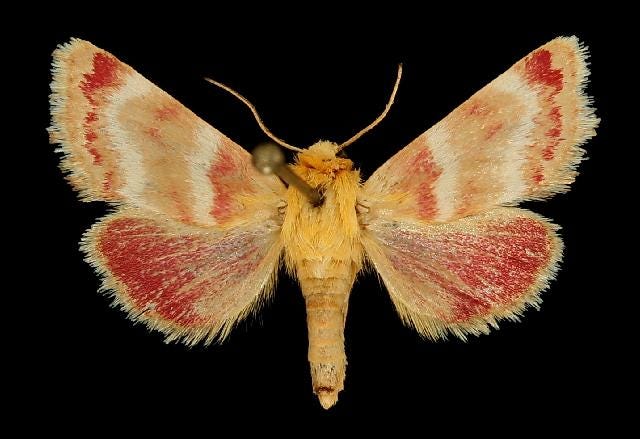
§28 The Baileya pauciradiata species, meantime, has two or three flower heads. “Each has a few three-lobed yellow ray florets around a center of yellow disc florets.” It takes all kinds. This species, often called a laxflower or a Colorado desert marigold, is the main source of food for a certain sand-dune-dwelling moth that looks like this:
§29 In order to find out for sure about trisomy 18, Grace had to undergo a procedure called chorionic villus sampling (CVS). A long, thin, hollow needle is inserted through the stomach and into the uterus to collect amniotic fluid and cells from the placenta. The risk of miscarriage is less than 1 in 100. The risk of severe infection is less than 1 in 1,000.
§30 The procedure started with an ultrasound, the first one we’d seen, and it looked like every other ultrasound you’ve seen but it was ours, and so the hairs on my arms stood at attention as if reporting for duty, or perhaps to honor this vague vision of our expected guest: the gray simulacrum of smudges and motion, our maybe baby made of clay. It should have been a time for cooing, but then the next part. The doctor cleaned Grace’s belly and told us to imagine a straw poking into crushed ice, collecting more bits with each poke. Okay, we said. You could see the needle enter on the ultrasound image, which was horrifying. I looked back and forth between the doctor inserting the needle into her abdomen out here in our world and the sonographic images depicting the world inside the womb. There was something uncanny, if that’s the word, about looking back and forth between the actual and the virtual in this way. And I remember that the virtual map of blacks and whites and grays on the screen, this visualization of high-frequency sound waves, felt more real to me than the actual bodies in the room with me. I remember the being’s limbs and the being’s head and the needle above, and I remember wondering about the being’s consciousness, I remember wishing that I knew how to pray so that I might pray that the being was not aware of what I was aware of, of the alien object penetrating its cozy home. I remember wishing that I knew how to pray so that I might pray that the information stored in the collected fluid would be one kind of information and not another kind. At the time, I was auditing a religious studies class at the university where Grace was teaching. I had just read the Gospel of John, and I remember that I fixated in that moment on the words, “For God so loved the world…” And the words had a righteous rhythm, a frequency beyond my reckoning that seemed to make an image in my mind, a map of blacks and whites and grays. I could sense the image but could not see it. For God so loved the world. I tried to access this freely give love—this grace. I tried to impose, by force of will, an outcome on the happenings around me. I tried to find the portion of my self suitable for using the freely given love as a channel to divine aid. I tried to pray, but I wasn’t sure how.
§31 Is human prayer a contingent accident or a convergent solution? Perhaps I was trying to pray out of a habit that is not my own, an echo of cultural evolution. Or perhaps prayer is older and more fundamental, like meaning and beauty and truth, the dearest inventions of our species. Or perhaps supplication is an ill-advised emergent property. The algorithm advantages desire and dissatisfaction and question asking. Dear God, we begin, and the voice in our head says please, please, please.
§32 Directly above Grace in the examination chair, there was a small window along a slant in the ceiling. Strange place for a window, but there it was. The whole time, Grace never looked at the ultrasound or anywhere else in the room, or at me—she was just looking straight up at the window. From my position, I could see tree branches through the window moving in the wind. The light was coming down at an angle just in front of Grace. You could see the particles of dust wiggling in the beam. Maybe there were little driblets of consciousness fizzing in the atoms of those particles of dust. I kind of doubt it, to be honest. But the floating bits of dust were there, as they always are, I guess, but normally you cannot see them. Their presence and dance became visible at that particular hour of day only by the ray of light from a distant star. And that first-person thingy, the internal thingy that is my self or my soul or my consciousness or my mind or whatever, it took note that dancing bits of dust and the distant star and me and my prayer and the material reality of the future, if there is such a thing, and the plum-sized fetus and the window and the light—all of it was a kind of gifted tapestry, the warp and woof of stuff, the hum of consciousness, the holy plane of time. God so loved the world.
§33 What it was like to be me at that moment was to be thankful: both for the abundance of the gift, and to be, myself, woven into the gift. And I looked at the image on the ultrasound, that glorious plum-sized potential, that miraculous ordering of cells, our uncanny little alien, and I looked at the bits of dust in the light, and I understood that sometimes, I can access this thing, this thing that is part of my self or my soul or my consciousness or my mind or whatever: I can so love the world.
§34 She has taught me so many things, my daughter, but this was the very first: She taught me how to pray.
§35 One time, Sean Carroll, the physicist who wrote the book about quantum mechanics, interviewed another guy named Sean Carroll, who is an evolutionary biologist. No relation between the two Sean Carrolls. It’s just a coincidence. The biologist Sean Carroll generally puts more emphasis on the random chance that Gould described over the relatively more predictable patterns theorized by convergence. Like Gould, Carroll is skeptical that if you “played the tape back” you would necessarily wind up with anything like humans, or dinosaurs for that matter. For one thing, there are all manner of external events. It just so happens that 66 million years ago, an asteroid hit the earth, and it just so happens that it landed in sulfur-rich rock in the Yucatan, producing a haze of sulfuric acid that blocked sunlight for decades. Would humans have come to be if the dinos hadn’t been wiped out by this particular slate of circumstances? Opinions differ, but maybe not. Maybe we’re a fluke. “The course of evolution is only the summation of fortuitous contingencies, not a pathway with predictable directions,” Gould wrote. If the asteroid took a different path, maybe the itty-bitty mammals who shared the planet with dominant dinosaurs would never have exploded in size and diversity. And then maybe there would be no smarty-pants apes to be self-conscious about consciousness, no Empire State building, no “Empire State of Mind,” no Substack posts, no sporks or culottes, marigolds but no Marigold.
§36 It sounds like a children’s song: I love the world and the world loves the desert marigold and the desert marigold loves the world and the desert marigold loves me and I love the desert marigold and the world loves me. But honestly? I think this is the situation, more or less.
§37 And don’t all of us love the sun?
§38 The combinatorial possibilities are nearly infinite, at least in theory. I cannot improve on the prose in Wikipedia: “The seed-like fruit is whitish, with no scales or bristles at the tip.”
§39 Upon consideration, I think I find these two possibilities equally breathtaking: 1) if the desert marigold was a stray accident, a random spin of contingencies, unfathomably unlikely or 2) if it was more or less inevitable, or something very like it, because of the elegance of its problem-solving apparatus. I do not find either possibility incompatible with our oldest stories of creation, the stories we intuit with a way of thinking that was either random or inevitable or something more mysterious still.
§40 An unruly companion, our consciousness. Maybe just an outcome randomly generated, like the number in Sean Carroll’s book or the topic of this post or the contingent particularities of this playing of the evolutionary tape. An accident, whatever that might mean, explicable in material terms in an indifferent universe. But even if that’s true, is that so bad? The gratuitous strangeness of it might be all the sweeter, then—sacred even. A splash of color in arid country.