
A Short, Strange Trip
Excerpt from John O’Connor’s new book—on the untold story of magic mushrooms, madness, and a search for the meaning of life in the Amazon

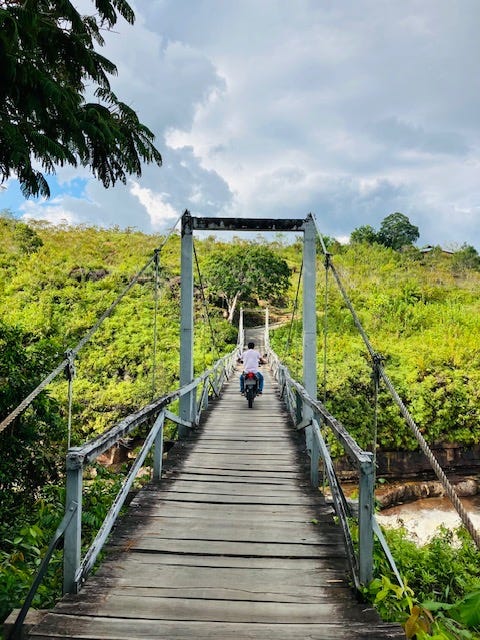
Hey y’all, I am honored and excited to present an excerpt here at Tropical Depression from A Short, Strange Trip: The Untold Story of Magic Mushrooms, Madness, and a Search for the Meaning of Life in the Amazon, a new nonfiction book by John O’Connor. I just ordered my copy and can’t wait. You should, too. If this post inspires you to get the book, please send me a picture of you reading it in a highly mannered pose.

Below is an introduction from John, who previously wrote The Secret History of Bigfoot: Field Notes on a North American Monster, which NPR hailed as “a wonderful book about one of the most ubiquitous myths in the U.S.”
In March 1971, a motley crew of “psychonauts”—explorers of psychedelic drugs and their potential to unlock the secrets of the mind—plunged into the remote Colombian Amazon in search of hallucinogenic plants. The group included Terence McKenna, a brilliant yet troubled refugee from the Berkeley barricades, and his brother Dennis. Convinced that a powerful combination of psilocybin mushrooms and DMT-containing yagé would hasten a global revolution, they prepared to enter hyperspace. “We had sorted through our ideological options,” Terence later wrote, “and we had decided to put all our chips on the psychedelic experience as the shortest path to the millennium, which our politics had inflamed us to hope for.” The return journey was, shall we say, complicated.
I learned about this years ago when I stumbled across Terence’s account of “The Experiment at La Chorrera,” as he called it, after the Colombian village where it all took place. Drawing on ideas gleaned from the experiment, the McKenna brothers went on to have an outsized impact on the psychedelic underground. Indeed, Terence and Dennis were among the first—if not the very first—to figure out how to cultivate magic mushrooms at home, sparking a seismic shift that opened faultlines to today’s so called “renaissance.” In 2023, I traveled to La Chorrera, where I worked alongside indigenous Uitoto and Bora people who bore witness to Terence’s peculiar experiment. My book is about that: the McKennas, La Chorrera, and their link to the present.
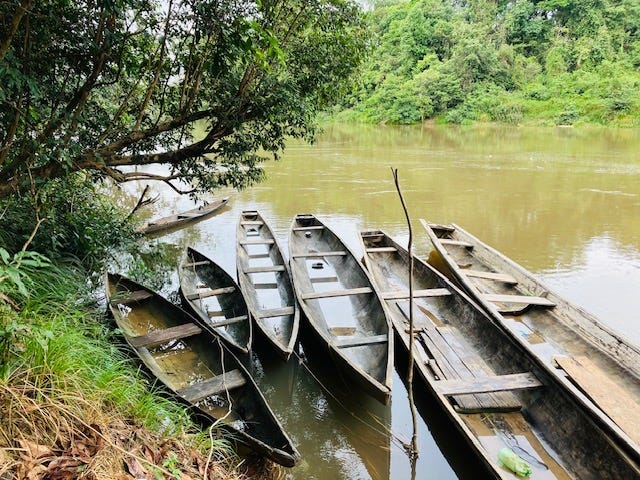
“I hate travelling and explorers.”
—Claude Levi-Strauss
It was raining again, flooding the narrow path and whistling along the banks of the Río Achote, a feeder stream to the Igara Paraná, a dozen miles downriver from La Chorrera. Warm rain, like in summer, even though it was technically winter. We moved quickly, single file through a tunnel of trees, the forest increasing in brilliance as we walked, some of us using philodendron fronds as makeshift umbrellas, having snapped them from their slender branches. For all the good they did. Rain fell so thickly it made the brims of our ball caps sag. It rose in puffs wherever it landed, like pounding fusillade. When the wind gusted, it blew water off our chins.
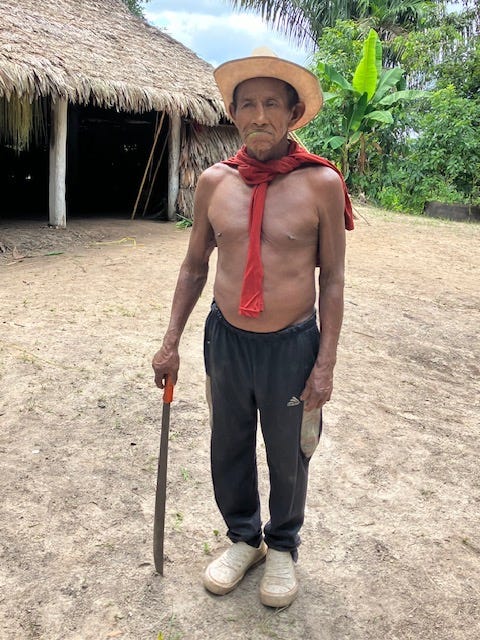
There were a bunch of us, six adults and maybe seven or eight kids. It was hard to keep track of everyone. The children ranged in age from three to sixteen, or thereabouts, and were roughly split between boys and girls. A few of the latter wore their faces painted a ceremonial crimson or ocher, their lips coal black, while some of the boys had streaks of lightsaber–green dye in their hair. I was near the front with Niky Fariratofe, a boy of about seven in a white T-shirt yanked up and ninja’d around his eyes and knockoff Crocs that were two or three sizes too big and kept sliding off his feet. Niky’s grandfather, Busileo Buinaje Attama, was steps ahead of us. A shockingly nimble seventy-four, Busileo sprang over downed trees and bobbed under errant vines with his machete slashing this way and that, clearing underbrush. What a thrill to find myself in a real wilderness—in the Amazon, no less—with two stout woodsmen seventy years apart in age. All I had to do was follow Niky and heed his advice while Busileo blazed our way: “Don’t touch this spiky plant. Or this toad. And this?”—Niky pointed to a stubby gray slug with ominous-looking spines on its back—“It stings. Really, really bad.”
On we went, through a green rotunda. I didn’t know for sure where we were headed. Something about a waterfall. The trees, some of whose tops climbed out of view, others as short as flagpoles, bounded us on either side. From the upper branches came the crow- like rattle of a red-throated caracara, an elegant jungle falcon with slender underparts resembling a pair of tight-fitting white trousers. Further on, a Miller’s saki, barely visible, cried plaintively as it rode the branches out of sight, no doubt bitching about the rain. Even for the Uitoto, these shy and burly monkeys, which fill an evolutionary void between sloth and Shar-Pei, are bucket-list terrain. We stood for a long while catching our breath, hoping for another glimpse.
Bringing up the rear was our leader, Elio de Jesús Buinaje, chief of Clan Garza (White Heron Clan). Lean and muscular with a sharp, handsome face and a brow creased with worry and care, Elio was roughly my age (fifty) but looked younger, as if he’d arrested time in his mid-forties. He wore a long-sleeved yellow soccer jersey, knee-high muck boots, and a dark-blue Red Sox cap I’d given him the day before. We’d met in person then for the first time, but our chain of WhatsApp messages stretched back to September, when we’d started ironing out details of this trip, so I felt like I already knew him a little. Intelligent but tough, small in stature but physically imposing, what I most respected about him, what I took to be his most chiefly quality, was an indomitable calm or steeliness. Like Buster Keaton in The General, where others saw impending disaster, Elio saw only confirmation that, as he’d once texted me, “Everything is possible.” He seemed, simultaneously, to have a lot weighing on him, most likely because he did, and in fact could be described as a man struggling for his people’s very survival. But he wore this burden coolly. He was good at his job, I suspected, if also a bit hard to read.
Another of Elio’s qualities I admired was a fierce protectiveness, both for us witless gringos and for a handful of Uitoto kids who were laboring to keep up. Now and again Elio dropped back to collect stragglers while reassuring the rest of us, with quick sidelong glances, that the weather wasn’t so bad after all. We also included: Brenda Buinaje, fourteen; Jhonev Fernando Buinaje, sixteen; Abel Buinaje, sixteen; Kelly Buinaje, twenty-three; her husband, Jhoan Bacca, twenty-one; and their three-year-old daughter, Kristell. All were part of Elio’s extended family.
And there was my friend Andrew Mudge, a filmmaker back in Cambridge and the Herzog to my Kinski in this part of the story. Andrew and I lived around the corner from each other. Our daughters were best friends. Tall with short, curly hair and dark-rimmed glasses, he wore baggy cargo shorts, a button-down shirt, and a pair of wafer-thin water socks, the only footwear he’d brought to Colombia, acquired online for $22, of which he was immensely proud.
We came to a culvert with a huge tree lying across it. Everyone picked their way up and over, one by one. Everyone, that is, except Andrew and I, who stood eyeing the churning maw warily. Little Niky stared back at us, his hands splayed up in the international sign for “WTF?” Oh, the shame! Andrew and I teetered across, making a bad job of it, and in the next moment the rain let up and the day turned suddenly balmy. Sunlight passed through fluttering leaves. A half a dozen blue morpho butterflies, rising above the leveled stream, ticked by in an instant.
At the top of the waterfall, we shucked off our shoes and walked to the edge. Elio kept watch from shore, with Busileo nearby sharpening his machete on a river stone. Water the color of corroded metal ran over our ankles and spilled twenty-five feet or so into a pool below. The streambed was flat and smooth and radiant. Car-size boulders scattered about looked scrubbed clean. First in was sixteen-year-old Jhonev, who backflipped dramatically off a ledge, landing with a burst of rusty spray. Then Niky, Brenda, and Kelly, briefly surfacing before vanishing under the falls. This I could handle, I told myself. Two, three steps and I was airborne, dropping through space like a felled tree. Emerging, I heard a chorus of laughter and turned to find my companions sitting on half-submerged rocks, their breath misting the air, black hair glued to their faces.
In True Hallucinations, as in all of his of writing about the “Experiment at La Chorrera,” which contains the hog’s share of three decades of creative output, Terence names just one La Chorreran, a young man named Basilio, who paddled him and Ev upriver one day to find yagé. Besides the chorro and the knoll house, where Terence spent a lot of time, La Chorrera itself is a blur. Its small dramas and imperatives, its languages and rivers, its birds and myths and quietude, and most crucially its people, Terence missed all of that. So preoccupied he was with uncovering the “hallucinogenically derived Gnostic Truth” that he failed to record much else. This isn’t entirely fair of me. Dude was twenty-four. His mom had just died. Lots of stuff was happening in that moment. And it’s not as though anyone, much less an outsider, could capture La Chorrera’s totality. But Terence’s omissions have always felt odd, given that he was (a) a gifted linear writer with a shrewd descriptive eye, and (b) a political radical whose utopian ideals, one might argue, were rooted in the peasantry. For all his democratic impulses, Indians remained mysterious and enigmatic. I also had an inkling that by hermitting himself away like he did, he missed out on a tremendous discovery: a storehouse of Indigenous hallucinogens grander than anything he’d imagined. We all have our blind spots. This was Terence’s.
I wanted my writing about La Chorrera to reflect a real world, not an imaginary one, while leaving room for the sorts of extraneous details that usually go missing in stories about poor places. I considered the village to be as much my subject as Terence. Things as I found them were different from what he described. Even the landscape failed to measure up in certain ways. But of course, like Terence, I was an interloper and, from the Uitoto POV, probably untrustworthy. Also like Terence, I didn’t speak Spanish, so most conversations passed my ears as, “Spanish Spanish Spanish, Beer, Spanish.” Andrew, who’d once lived in South America, was my translator. I know I missed a lot. But I tried all the same.
On the hike out, Elio revealed himself to be a gifted amateur botanist who could name virtually every plant and tree in the forest. That’s extraordinary, to say the least, as Colombia is one of the most ecologically diverse nations on earth, with some fifty thousand plant species, seven thousand of them endemic. Sensing my interest, Elio paused to ID things for me, giving the word first in Uitoto and, when he knew it, in Spanish:
Royinory = Orquídea (Orchid, in this instance a sherbert orange kind growing all along the trail).
Yarumo = Yagrumo (A species of flowering cecropia with broad, silvery leaves, known elsewhere as the trumpet tree or snakewood).
Pui o caraná = Palma de pui (A kind of wax palm with two opposing brackets of four leaves that’re plaited together to make the roof and walls of the maloca, or communal long house).
Emairai = Árbol del Zorro (A flowering acerola bush, part of the Malpighiaceae family, which includes the liana Banisteriopsis caapi, a principal ingredient of yagé).
Unazi = Yagé (More on this in a sec).
Closer to the maloca where we were staying, we passed through groves of planted palms, guava, manioc, pineapple, and coca.1 The last of these, Elio reminded us, was a sacred plant, revered by the Uitoto above all others. As ubiquitous in Putumayo gardens as hydrangeas are in Cape Cod’s, coca (jíibie), together with tobacco (díue), is the Uitotos’ drug of choice. Andrew and I had gotten our first lesson in coca the night before, when we stayed up late watching Elio’s younger brother, Carlos, carefully roast and pulverize the smooth, waxy leaves in a huge mortar and pestle, then mix them with the ashes of yarumo to produce a matcha-green powder called mambey (it even tastes a little bit like matcha).
If the Uitoto had a formal constitution, mambeing—present participle, meaning to make/ingest mambey— would be mentioned in a first article clause about the pursuit of happiness. The love and work of family and clan, the link to ancestors and origin myths, to the seasons, to the eternal circle of all creatures of the forest, are bound up with mambey. It’s not so different, perhaps, from the Catholic notion of transubstantiation, wherein bread and wine become an earthly bridge to a metaphysical Other. Or for that matter, from Terence’s notion that magic mushrooms are alien emissaries touched by the divine (theophagy—eating the God to become the God—has been transmuting humans into deities since time immemorial). Except that mambey is eaten morning, noon, and night, always with a gooey black tobacco paste called ambil, made by boiling mature leaves in clay pots and mixing it with salts extracted from wild lilies (zúuie), palm hearts (ruiriyi), the bark of Maripa (jarígorai) and other palms. Tobacco is taken first, licked from a spoon or a finger dipped into a container like a hotel shampoo bottle, which all Uitoto men keep close by, followed by a tablespoon or more of mambey, stored in something like a Folgers tub. Both are staples and sacraments, akin—in a further mixing of metaphors—to coffee and cigarettes. That is, if coffee and cigarettes allowed you to clasp your hands around existence itself.
“The professors always ask, ‘What is mambey?’” Elio told me. “Mambey isn’t the stuff you put in your mouth. It’s your heart and soul. What you have inside of you is mambey. You translate its meaning. Mambey is a sacred mind state, each second, each hour, of every day. It helps you speak to the children of the rain and to the sun. It’s about connecting to the rhythms of nature and to the animals.” There’s more to it than that, but not much more that a gringo can grasp. Suffice it to say, overstating mambey’s significance would be tough.
Uitoto women use tobacco,2 but mambey is restricted to men, who consume upward of twenty ounces a day, more than a ton over a lifetime. Neither spat nor swallowed, it’s instead allowed to dissolve in the mouth and seep down the throat, numbing it. The effect is mildly intoxicating, an uptick in energy and mood verging on the euphoric, but minus the existential crash of cocaine. The best way I can describe it is by recalling how Andrew, after mambeing one afternoon upriver from La Chorrera, crouched in the bow of our canoe and, arms spread wide like Leo in Titanic, bellowed, “Oooooooooooooooowhoooo!”
“Coca was born in Colombia,” notes Wade Davis. Indigenous South Americans have cultivated it for at least eight thousand years. The leaves of certain varieties—Erythroxylum coca being the most widely dispersed— can be used to produce cocaine, which was first isolated by a German chemist in 1860. The cultivation and distribution of coca has been illegal in Colombia since 1947, but the law is randomly enforced. While indigenous people like the Uitoto have suffered immensely from U.S.-sponsored aerial fumigation programs, such as under Plan Colombia, which sprayed carcinogenic herbicides over 4.5 million Amazonian acres, in some of the poshest neighborhoods of Cali, Davis tells us, coca is a popular ornamental shrub.
The oldest shamanic sacrament, tobacco is likely the most ancient cultivated plant in the Americas, grown in Columbus’s time from southern Alaska all the way to Chile. To the Uitoto, as Walt Hardenburg noted, the licking of tobacco is akin to the “most solemn oath.”